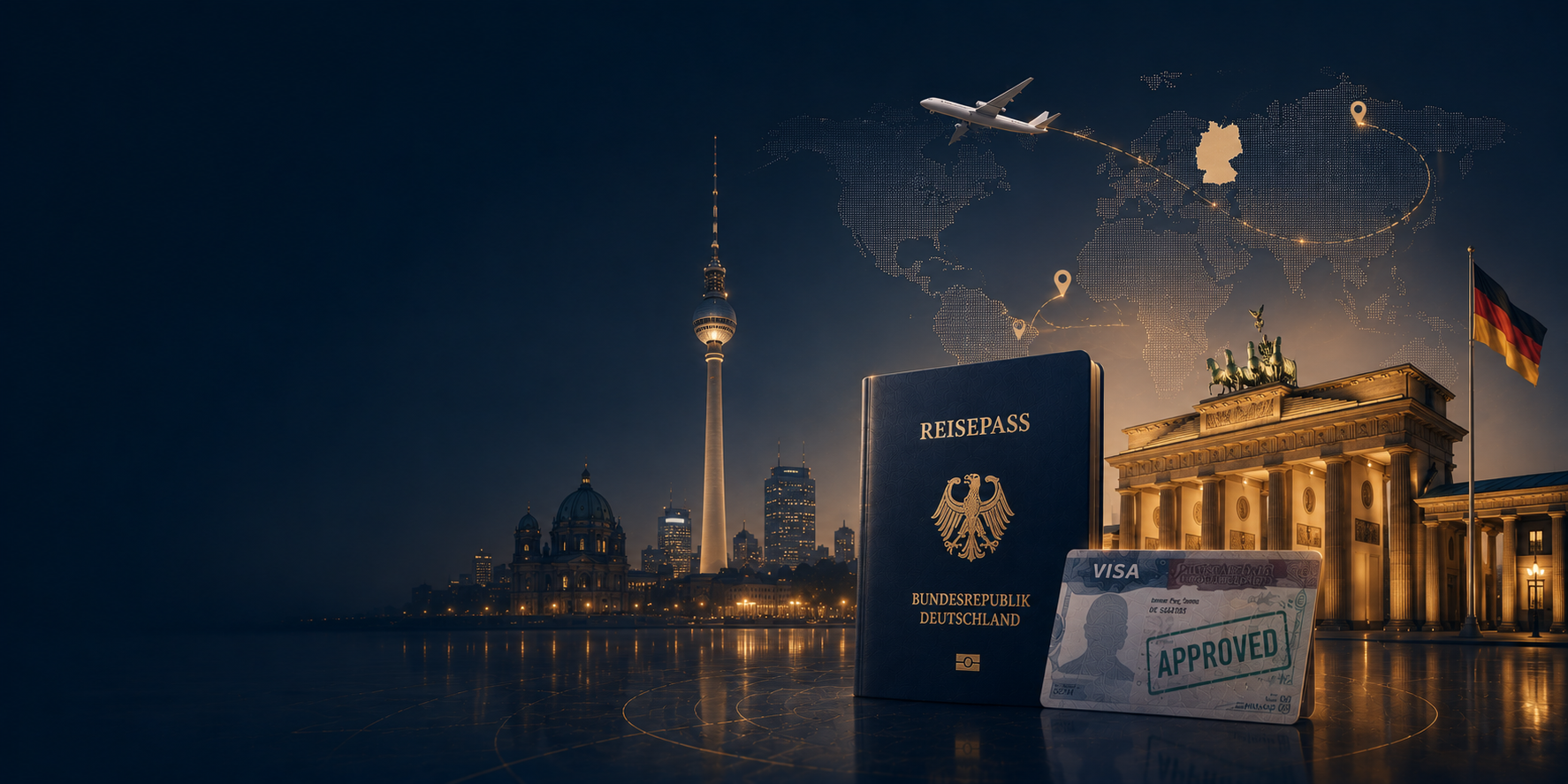
Move to Germany and Start Your European Career.
Europe's largest economy has a shortage of over 570,000 skilled workers and has restructured its immigration system to fill it. For Indian professionals in IT, engineering, healthcare, and trades, Germany offers genuine demand and a route to European PR.
Why Germany Is the Destination Indian Professionals Can No Longer Ignore
Germany passed the most significant skilled immigration reforms in a generation. The Opportunity Card was introduced, EU Blue Card thresholds adjusted, and recognition pathways streamlined.
The fourth largest economy in the world. Its industrial base is globally dominant. Its technology sector operates in English and is growing rapidly.
Germany's social infrastructure, public transport, education, safety, represents a quality of daily life that very few countries match.
Not the easiest route to Europe, but for the right profile, the most rewarding one.
What Germany Offers Indian Professionals and Their Families
Career & Earning Potential
German salaries are competitive within Europe and significantly higher than India. An experienced software engineer in Munich earns €60,000–€100,000+. Strong employment protections, mandatory paid leave, and regulated working hours create a genuinely different quality of working life.
Healthcare
Germany's statutory health insurance covers all employed residents with comprehensive coverage: GP visits, specialist care, hospital treatment, prescriptions, and dental. Consistently ranked among the best in Europe.
Education
Public schools are well-funded. Germany's universities, TU München, RWTH Aachen, Heidelberg, are world-class institutions that charge minimal or zero tuition fees even for residents. A generational advantage.
Safety & Quality of Life
Among the safest and best-governed countries in the world. Dense public transport network. Clean, well-planned cities. 30 days paid annual leave is standard. Work-life balance is a cultural value.
Cost of Living Advantage
Compared to London, Sydney, or any major American city, Germany's cost of living, outside Munich, is significantly more manageable. Berlin offers an unusual combination of opportunity and affordability.
Path to Permanent Residency
Standard route: 5 years to Niederlassungserlaubnis. EU Blue Card: as little as 21 months with B1 German. German citizenship after 6–8 years. A German passport is an EU passport, visa-free access to 190+ countries.
More Routes Than Most Applicants Know Exist
Germany Opportunity Card (Chancenkarte)
Enter Germany without a job offer. Points-based. Work up to 20 hours/week while searching. No lottery. The most significant German immigration innovation in a decade.
Explore Opportunity CardEU Blue Card, Fast Track for High Earners
Residence and work permit for professionals with a recognised degree and qualifying salary (€43,800+). Fastest route to permanent residency, 21 months with B1 German.
German Skilled Worker Visa
For professionals with a recognised qualification and a job offer. No minimum salary threshold, but your occupation and qualification must meet German recognition standards.
Germany Job Seeker Visa
Six-month stay to search for work, requires qualification recognition before entry. The Opportunity Card is generally more accessible for most Indian applicants.
Germany Student Visa
World-class education at minimal or zero tuition. Creates a direct pathway to post-study work, German experience, and ultimately permanent residency.
Explore Student VisaWhere Indian Professionals Are Building Their Lives
Berlin
Germany's capital and most internationally connected city. Dynamic tech and startup ecosystem. Lower cost of living than Munich or Frankfurt. English-friendly professional environment. Growing Indian community.
Munich (München)
Germany's economic powerhouse. Home to BMW, Siemens, Allianz. Highest salaries alongside highest cost of living. Established Indian community. Proximity to the Alps.
Frankfurt
Germany's financial capital and seat of the ECB. Major international airport. Large English-speaking professional population. Strong demand for finance and technology talent.
Hamburg
Germany's second-largest city and primary port. Strong technology sector, aviation industry (Airbus). Cosmopolitan and outward-looking.
Stuttgart
Heart of Germany's automotive and mechanical engineering industry. Home to Mercedes-Benz, Porsche, Bosch. For mechanical engineers, the most concentrated destination.
Düsseldorf & Rhine-Ruhr
Germany's largest metro region. Major centre for telecommunications, retail, and professional services. Significant Indian community. Lower cost of living than Munich or Frankfurt.
Where Employers Are Actively Hiring International Talent
Information Technology
Software developers, data engineers, cybersecurity specialists, among Germany's most critically short-staffed occupations. Designated as a shortage occupation with lower EU Blue Card thresholds.
Engineering
Mechanical, automotive, electrical, and industrial engineers are the backbone of Germany's economy. Munich, Stuttgart, and the Rhine-Ruhr region have the highest concentrations of engineering employers.
Healthcare
Severe shortage of doctors, nurses, physiotherapists, and medical technicians. Streamlined recognition pathways. Nurses with B2 German are among the most actively recruited international professionals.
Skilled Trades
Electricians, plumbers, HVAC technicians, and construction tradespeople are in acute shortage. Germany's construction boom is creating sustained demand domestic training cannot fill.
Natural Sciences
Chemists, physicists, biologists, and research scientists are in strong demand across pharmaceutical, chemical, and research sectors. Max Planck and Fraunhofer institutes are world-class employers.
Finance & Accounting
Financial analysts, auditors, and controllers are in steady demand, particularly in Frankfurt's financial ecosystem.
Indian Professionals Who Made the Move
“I'd been trying to get German interviews for over a year from Hyderabad. The moment I landed on the Opportunity Card, everything changed. Three serious interviews in my first six weeks. Job offer in week ten.”
, Client, Software Engineer, now in Berlin
“My qualification recognition came back as partial. I panicked. 91 Travel explained the compensatory measures process, managed the response. Full recognition confirmed. EU Blue Card submitted the following week.”
, Client, Mechanical Engineer, now in Munich
“I had 5 Opportunity Card points, one short. 91 Travel identified that my English proficiency certificate hadn't been included. One additional document. Six points. Application submitted within days.”
, Client, Financial Analyst, now in Frankfurt
“The German job search advice was as valuable as the visa application itself. I knew which platforms to use, how to position my Indian experience, and what to expect from German interviews.”
, Client, Civil Engineer, now in Stuttgart
Questions About Germany Every Week
Do I need to speak German?
Not for the initial visa, but German significantly improves employability, daily life, and speed to permanent residency. We recommend starting before you arrive. Even A2 on arrival makes a meaningful difference.
How does Germany compare to Canada or Australia?
Germany offers faster PR for EU Blue Card holders (21 months with B1 German). The Opportunity Card gives Germany a unique advantage: enter without a job offer. German salaries are competitive within Europe but lower than US or Australian equivalents for some occupations.
What is the EU Blue Card?
A premium residence permit for professionals with a qualifying salary (€43,800+) and recognised degree. Primary advantage: accelerated PR in 21 months with B1 German. Also provides easier family reunification.
Can my family come with me?
The Opportunity Card is individual. Once you convert to a full work visa, family reunification is possible. EU Blue Card holders can bring family immediately, spouses receive immediate work authorisation.
What taxes will I pay?
Germany's progressive tax ranges from 0% to 42%, with 45% above €277,826. Social contributions add approximately 20% of gross salary. Effective take-home for mid-range salaries is typically 60–65% of gross.
Germany Is Open. The Question Is Whether Your Profile Is Ready.
A free 45-minute session covers your qualifications, Opportunity Card points, EU Blue Card eligibility, and target sector, and tells you which German pathways are realistic.
P.S. , The professionals moving through fastest started early, before processing times extended. Germany's labour shortage isn't going away, but the window of an uncongested new system is finite.