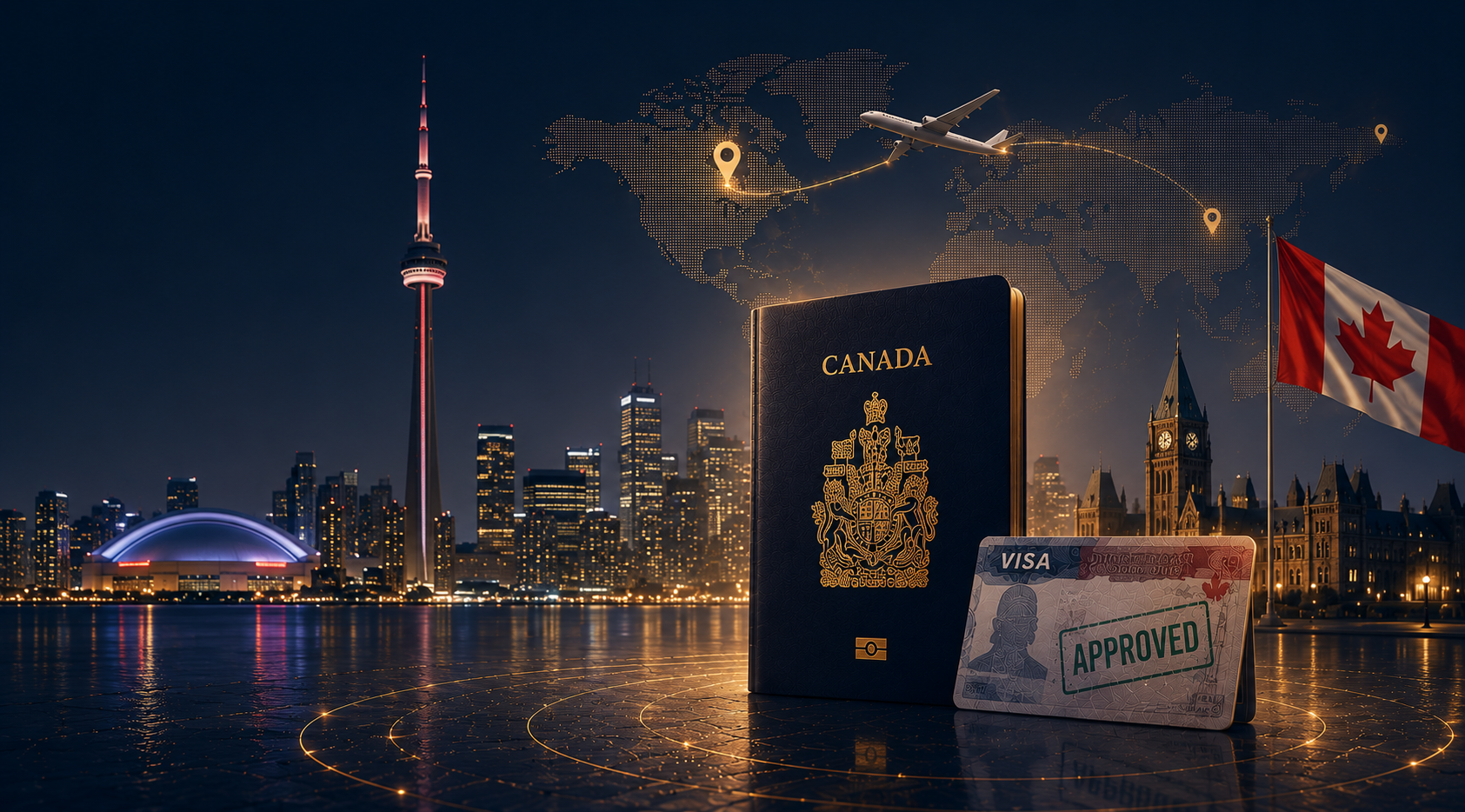
Canada Is Not the Easiest Country to Immigrate To. It Is the Most Rewarding One to Get Right.
Stable. Multicultural. Professionally ambitious. Canada has built one of the most structured skilled immigration systems in the world. For Indian professionals with the right profile and strategy, permanent residency is not a distant aspiration. It is a 12 to 24 month process.
What Canada Offers That Other Destinations Don't
Canada is the most chosen immigration destination for Indian professionals, not because it is the easiest, but because it is the most deliberately engineered for skilled immigration success. The points-based system is transparent. The provincial programs are diverse. The Indian community, over 1.8 million strong, is deeply established.
Canada offers something the US cannot: a realistic timeline. No decade-long green card backlogs for Indian nationals. No lottery dependency. A system that rewards preparation and strategy with a clear, achievable outcome.
Professional recognition at scale. Canada's technology sector, healthcare system, engineering industry, and financial services actively recruit internationally trained professionals. Cities like Toronto, Vancouver, Calgary, and Ottawa compete globally for skilled talent.
A multicultural society built for integration. Canada's official multiculturalism policy is a constitutional commitment. Indian culture, food, community, and religious life are deeply embedded. The transition from Hyderabad or Bangalore to Brampton or Surrey is culturally manageable.

What Canada Offers Skilled Professionals and Their Families
Career and Earning Potential
Canada's technology, healthcare, engineering, and financial services sectors are among the most competitive employers of internationally trained professionals. Toronto and Vancouver are global tech hubs. Calgary and Edmonton are engineering and energy centres.
Universal Healthcare
As a permanent resident, you and your family are covered by Canada's publicly funded provincial healthcare system. No medical bills, no insurance premiums beyond standard provincial contributions. For families, this is one of the most significant quality-of-life differences.
World-Class Education
Canadian schools rank among the best in the world. PR holders pay domestic tuition rates, a fraction of international fees. Children access the public school system from day one. Universities like U of T, McGill, UBC, and McMaster are globally ranked.
Safety and Stability
Canada consistently ranks in the top tier of global safety and political stability indices. For professionals and families, this stability is foundational to long-term planning.
Path to Citizenship
Three years of physical presence as a permanent resident qualifies you for Canadian citizenship. A Canadian passport provides visa-free access to over 180 countries, including the US, the EU, the UK, and Australia.
Established Indian Community
In cities like Toronto, Vancouver, Calgary, and Brampton, the Indian community is deeply established, with cultural infrastructure, religious institutions, and professional networks that make the transition far less disorienting.
Multiple Routes. One Goal. The Right One Depends on Your Profile.
Express Entry: The Fastest Federal Route
Canada's primary immigration management system for skilled workers. Points-based, fast. Target processing of six months from ITA. Three programs feed into it: Federal Skilled Worker, Canadian Experience Class, and Federal Skilled Trades. Category-based draws for healthcare, STEM, trades, and French speakers offer lower CRS cutoffs.
Explore Express EntryProvincial Nominee Programs: The Strategic Route
Canada's 13 provinces run their own immigration streams. A nomination adds 600 CRS points, making an ITA virtually guaranteed regardless of base score. For applicants with CRS scores between 350 and 490, PNPs are often the fastest available pathway.
Explore PNPCanada Work Visa: The Employment-First Route
For professionals with a Canadian job offer or active employer relationships. Canadian work experience adds significant CRS points. A work permit pathway can be the fastest route to building the PR-eligible profile you need.
Explore Work VisaCanada Student Visa: The Long-Term Route
For younger professionals or those whose qualifications benefit from Canadian upgrading. Post-Graduation Work Permits, Canadian work experience, and enhanced Express Entry scoring make the study-to-PR pipeline one of the most robust long-term strategies.
Explore Student VisaCanada Tourist Visa: Temporary Entry
Visit family, explore the country, or attend professional events. For some profiles, a visitor visa serves as a practical first step toward understanding the job market from inside the country.
Explore Tourist VisaCanada Economic Immigration: The Full Picture
A comprehensive overview of all economic immigration streams including Express Entry, PNP, Atlantic Immigration Program, Start-Up Visa, and more. For professionals who want to understand every available pathway before deciding.
Explore Economic ImmigrationWhere Indian Professionals Are Building Their Lives
Toronto, Ontario
Canada's largest city and financial capital. The largest Indian diaspora in Canada, over 1.3 million South Asians in the GTA. A global technology, banking, and professional services hub. The deepest job market in Canada.
Vancouver, British Columbia
Canada's Pacific gateway and a global technology hub. Strong Indian community in Surrey, Burnaby, and Abbotsford. High cost of living offset by top technology sector salaries and one of the most beautiful urban settings in the world.
Calgary, Alberta
Canada's energy capital and one of the fastest-growing economies. Strong demand for engineering, construction, and technology professionals. More affordable than Toronto or Vancouver with no provincial income tax.
Edmonton, Alberta
Alberta's capital and the fastest-growing major city by population. Lowest cost of living among Canada's major cities. Strong demand for skilled tradespeople, healthcare workers, and engineers.
Ottawa, Ontario
Canada's capital. Strong demand for technology professionals and government services workers. A measured, high-quality-of-life city with a deeply educated professional population.
Montreal, Quebec
Canada's second-largest city. A global hub for AI research, aerospace, and creative industries. Quebec has its own immigration system, the Quebec Skilled Worker Program. Lower cost of living with a distinctly European urban culture.
Halifax, Nova Scotia
One of Canada's fastest-growing Atlantic cities. Accessible PNP pathways, lower cost of living, and a deliberate provincial effort to attract skilled immigrants. One of the most welcoming entry points for professionals open to Atlantic Canada.
Winnipeg, Manitoba
Growing professional services, healthcare, and technology centre. Manitoba's PNP is one of the more accessible for a broad range of occupations, making Winnipeg a strategic destination for applicants whose occupation is competitive in that province.
Where Employers Are Actively Hiring International Talent
Information Technology
Software developers, data scientists, cloud architects, cybersecurity specialists, and IT project managers are among the most consistently in-demand occupations. Toronto and Vancouver have established tech ecosystems. Ottawa has a strong government technology sector. Category-based Express Entry draws have specifically targeted STEM occupations.
Healthcare
A structural shortage of doctors, nurses, pharmacists, and allied health professionals that domestic training cannot address. Several provinces have specific PNP streams for internationally trained health professionals. Healthcare occupations appear consistently in category-based draws.
Engineering
Civil, mechanical, electrical, structural, and chemical engineers in sustained demand across construction, infrastructure, and energy sectors. Professional registration through provincial engineering associations is required for independent practice.
Skilled Trades
Electricians, plumbers, welders, HVAC technicians, and heavy equipment operators in acute shortage nationally, particularly in Alberta, BC, and Saskatchewan. Red Seal certification makes you among the most straightforwardly employable immigrants in Canada.
Finance and Accounting
CPAs, financial analysts, auditors, and investment professionals in steady demand in Toronto and Vancouver's financial services sectors. CPA Canada membership is the standard benchmark for internationally trained accountants.
Construction and Infrastructure
Canada's federal infrastructure investment commitment is driving sustained demand for project managers, quantity surveyors, site supervisors, and construction professionals across the country.
Indian Professionals Who Made the Move
“I had been in the Express Entry pool for 14 months with a score of 441. 91 Travel identified a Manitoba PNP stream I qualified for, applied, got the nomination, and my ITA came in the next federal draw. I am now a permanent resident in Winnipeg.”
, Client, IT Project Manager, Winnipeg, Manitoba
“We came as a family. 91 Travel structured both our profiles to maximise partner skills points, identified the right PNP stream for my occupation, and managed the documentation for both of us simultaneously. PR granted. We are in Brampton.”
, Client, Pharmacist, Brampton, Ontario
“My ECA had assessed my Master's at the wrong level, costing me 14 CRS points. 91 Travel caught it, got it corrected, and those points made the difference between waiting indefinitely and receiving an invitation in four months.”
, Client, Mechanical Engineer, Calgary, Alberta
Questions About Canada Every Week
How long does it take to get Canadian permanent residency?
Express Entry, from optimised profile to PR grant, typically runs 12 to 18 months for well-prepared applications. PNP pathways add provincial processing time, total timelines of 18 to 24 months are common. The biggest variable is how long you wait for an ITA, determined by your CRS score and draw competition.
What CRS score do I need?
The minimum to enter the pool is 67 points for FSWP. Competitive scores for general pool invitations have recently ranged from 480 to 540+. Category-based draws and provincial nominations change this equation significantly. We assess your score honestly in the first session.
Does my family come with me?
Yes. Your spouse and dependent children are included in your permanent residency application. Your spouse's English proficiency and skills assessment can also contribute points to your CRS score.
Do I need to speak French?
French is not required for most federal pathways but adds significant CRS points and opens Quebec's separate immigration system. Even functional French can add meaningful points. We recommend a TEF assessment for any applicant with French language background.
Is Canadian PR better than a work permit?
A work permit is temporary and tied to a specific employer. PR gives you the right to live, work, and study anywhere in Canada, access to social services, and a pathway to citizenship in as few as three years.
Canada Is Achievable. The Strategy Makes the Difference.
A free 45-minute counselling session covers your occupation, qualifications, language scores, family situation, and timeline, and gives you a clear, honest picture of your best pathway to Canadian permanent residency.
P.S. , Canada actively wants skilled professionals like you. The system is designed to let you in, if your profile is optimised, your documentation is complete, and your strategy accounts for both federal and provincial pathways. Every week you spend researching without acting is a week your CRS score stays where it is and the policy environment shifts. One conversation changes that.